
For Professionals
BEHAVIOR IS VISIBLE.LEARNING IS LARGER.
A professional may see the behavior that brought a dog into the room.
Latent Minds asks what developmental history, environmental information, relationships, boundaries, patterns and prior experiences may also be present behind it.
This framework explores canine learning beyond trained responses — examining how dogs gather information, form expectations, interpret language, navigate environments and develop patterns of decision-making.
A Different Level of Question
THE BEHAVIOR MAY BE THE BEGINNING OF THE QUESTION.
Professionals are often asked to address what a dog is doing.
Barking · Pulling · Chasing · Avoiding · Guarding · Ignoring · Reacting · Refusing
Latent Minds adds another layer of inquiry:
What has the dog learned about the environment in which that behavior occurs?
What information consistently precedes it?
What expectations have developed?
What relationships, boundaries or opportunities surround it?
And what is the dog learning when nobody is actively instructing?
Behavior can be observed.
Development must be interpreted.
A training question may ask:
“How do I produce the desired response?”
A developmental question may also ask:
“What does this dog understand about the situation when the prompt is gone?”
These questions do not have to be enemies.
Latent Minds is interested in the second question because it may reveal information that performance alone cannot.
WHAT THE FRAMEWORK EXAMINES
01
COGNITIVE DEVELOPMENT
How understanding, judgment and self-regulation may develop through experience.
02
LATENT LEARNING
What dogs may learn without immediate reinforcement or visible performance.
03
ENVIRONMENTAL INFORMATION
How places, access, movement, repetition and consequences become meaningful.
04
CONTEXTUAL LANGUAGE
How words may acquire meaning through lived experience rather than isolated drills.
05
RELATIONSHIP
How social connection and interaction become part of the dog’s learning environment.
06
AUTONOMY
How appropriate opportunities to observe, choose, investigate and recover contribute to development.
07
DEVELOPMENTAL HISTORY
How earlier experiences may become part of the context through which later behavior is understood.
An Important Distinction
COGNITIVE DEVELOPMENT DOES NOT MEAN PASSIVITY.
Humans still manage safety.
Humans establish boundaries.
Humans determine access.
Humans communicate.
Humans create experiences.
Humans intervene when necessary.
The distinction lies in what those experiences are intended to develop.
The objective is not the absence of influence.
It is greater understanding of what that influence is teaching.
The Professional Opportunity
A FRAMEWORK TO EXAMINE, QUESTION AND DEVELOP.
Latent Minds is being developed not only for puppy families and breeders, but also as a framework professionals can examine critically.
The book establishes the language and developmental model first.
Future professional education may explore case interpretation, cognitive development, breeder-to-family continuity, developmental observation and application of the broader Latent Minds framework.
AUTHORITY REQUIRES CURIOSITY.
Latent Minds intends to distinguish carefully among:
Established research
Developmental interpretation
Latent Minds methodology
Observational and case evidence
The purpose is not to end the conversation about canine learning.
It is to widen it.
The Foundation
THE PROFESSIONAL CONVERSATION BEGINS WITH THE BOOK.
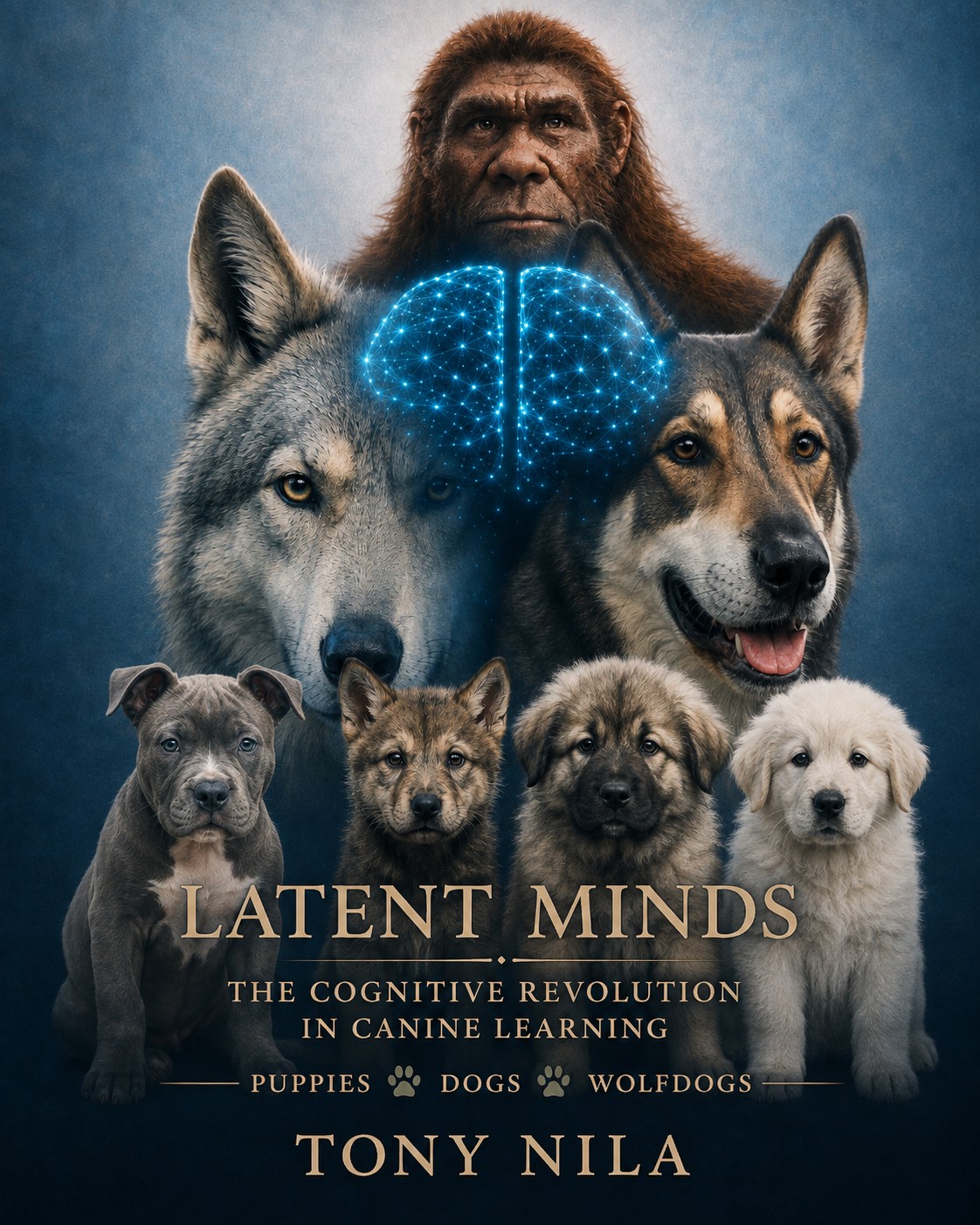
Latent Minds: The Cognitive Revolution in Canine Learning develops the framework in full before future professional education is introduced.
FOLLOW THE WORK AS IT DEVELOPS.
Join the list for publication updates and future developments for owners, breeders and canine professionals.