Learn
THE QUESTIONS CONTINUE HERE.
Learning about dogs can become larger than learning what to make them do.
This learning library is being developed as a place to explore cognition, development, environment, language, boundaries, relationship and the experiences through which understanding takes shape.
Start Here
THE CORE IDEAS.
Dogs learn constantly — through observation, movement, consequence, relationship, access, environment, repetition, social experience and change — including when nobody is conducting a training session. These are the working ideas the book develops in full.
COGNITIVE DEVELOPMENT
How understanding, judgment and self-regulation develop through experience.
LATENT LEARNING
What dogs may learn without immediate reinforcement or visible performance.
NATURAL BOUNDARIES
How space, access, consequence and environment can carry information.
CONTEXTUAL LANGUAGE
How words acquire meaning through lived experience rather than isolated drills.
ENVIRONMENTAL UNDERSTANDING
How dogs learn territory, patterns, expectations and the structure of daily life.
SOCIAL CONNECTION
How relationship and experience influence the way dogs orient to and learn from people.
AUTONOMOUS DECISION-MAKING
The progression from constant human direction toward increasingly appropriate independent choices.
Learning Is Larger Than Training
Trained Performance
What response can the dog produce?
Developing Understanding
What does the dog know, expect, recognize or decide when the prompt is absent?
The Latent Minds Method, a canine cognitive development program, does not require these questions to compete. It asks what becomes visible when both are examined.
The Shape of the Curriculum
HOW THE FRAMEWORK UNFOLDS.
01
THE CURRICULUM IS SEQUENTIAL
Development is intended to unfold progressively rather than as a collection of disconnected exercises. Earlier experience becomes information for what comes next.
02
THE EARLIEST FOUNDATION
A puppy's first developmental foundation is formed through the mother and the breeder — before the puppy ever goes home.
03
TWIN BEHAVIORS
Some experiences work indirectly. Twin Behaviors are indirect experiences that may prepare a puppy for a later visible behavior.
04
NATURAL BOUNDARIES
Natural boundaries involve understanding and choice. Unlike a physical barrier, the information is carried by space, access and consequence.
05
TERRITORY, DRAWN PROGRESSIVELY
Territory and cognitive mapping develop progressively. In Stage 2 the map is drawn in gray Home Territory, yellow Open Territory and the blue Educational Line. Stage 3 lifts that broad line. The Forever Rules retain the principles without bringing the broad Educational Line back.
Program protocol — from the Latent Minds curriculum
A Note on Sources
HOW TO READ THESE IDEAS.
This project speaks in four distinct voices, and the difference matters:
ESTABLISHED RESEARCH
Research on learning and cognition informs the discussion. This site does not present specific studies as proof of the framework.
TONY'S INTERPRETATION
How Tony reads and connects that research — interpretation, openly labeled as such.
PROGRAM PROTOCOL
The Latent Minds curriculum itself: what is practiced, in what order, and why.
OBSERVATION & CASES
What Tony has seen in practice — shared as observation, not as proof.
Nothing here claims the framework is scientifically proven — and nothing here argues that training is ineffective.
The aim is a wider question.
Ways to Explore
ONE FRAMEWORK. DIFFERENT DOORS IN.
01
PUPPY OWNERS
Development, relationship, boundaries, language and everyday learning from the first weeks onward.
Puppy Development03
WOLFDOG OWNERS
The framework grew from work with dogs and wolfdogs; the developmental questions apply to both.
Wolfdog Training05
CANINE PROFESSIONALS
Learning and behavior through a broader cognitive and developmental lens.
For Professionals06
THE BOOK
Latent Minds: The Cognitive Revolution in Canine Learning — the framework developed in full.
Explore the BookWolfdog Education
WOLFDOG ARTICLES.
Complete articles by Tony Nila on wolfdog training, puppies, behavior and family life — each one a full reading, not a summary.
01
Wolfdog Training vs. Traditional Dog Training
Why reward-and-command training often frustrates wolfdogs, and how a cognitive development approach works with their nature instead.
Read Article02
How to Raise a Wolfdog Puppy
The early development period, bonding, calm structure and boundaries that shape a stable adult wolfdog.
Read Article03
Understanding Wolfdog Behavior Problems
Why common wolfdog behavior issues usually stem from developmental and environmental factors, not stubbornness.
Read Article04
Are Wolfdogs Good Pets?
What a wolfdog is, how they differ from domestic dogs, the common challenges, and who they suit.
Read Article05
Do Wolfdogs Make Good Family Pets?
Social bonds, sensitivity, children and supervision, and what makes a household suitable for a wolfdog.
Read ArticleFor the bigger picture, visit Wolfdog Training & Cognitive Development.
From the Book
THE LIBRARY BEGINS WITH THE BOOK.
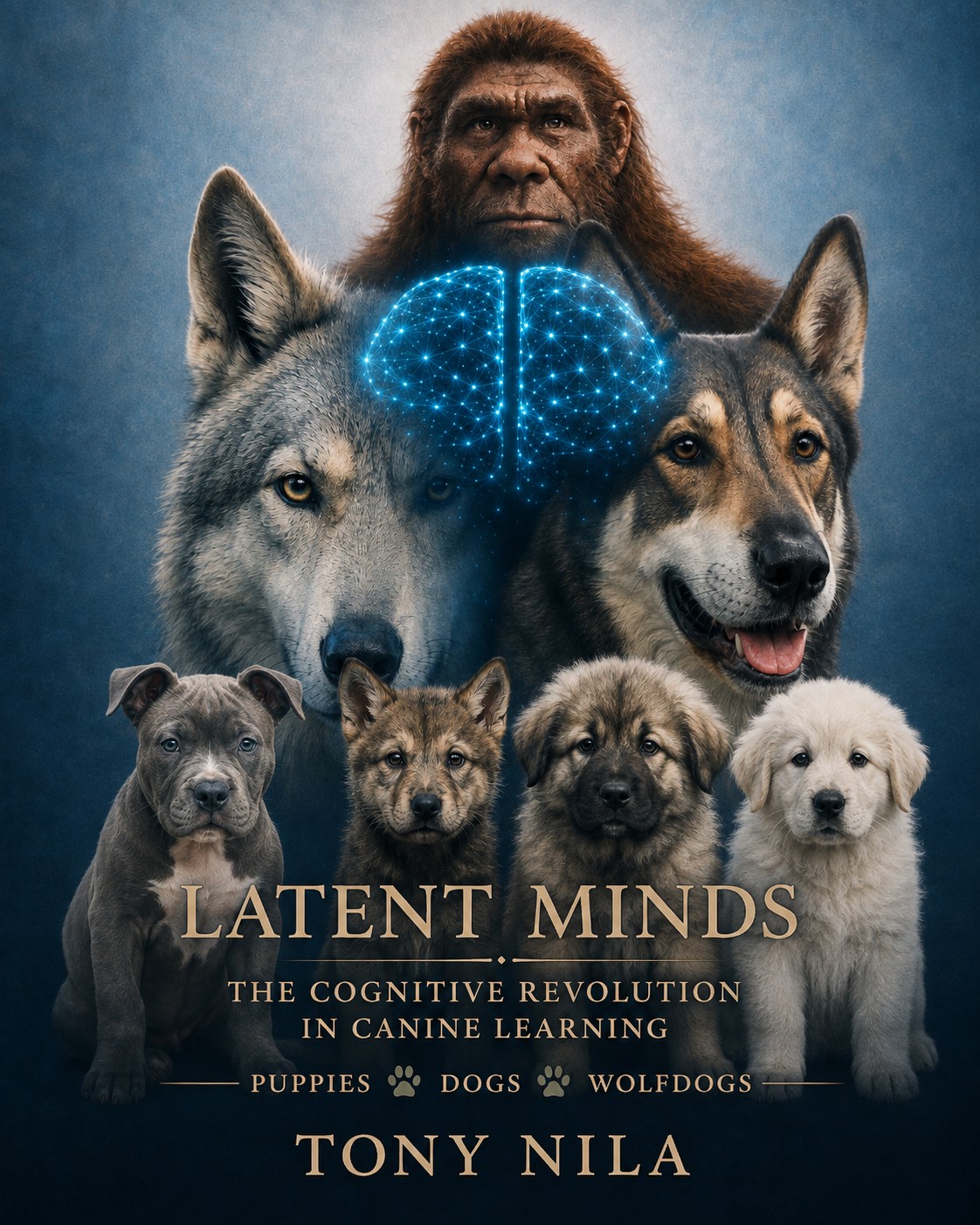
Latent Minds: The Cognitive Revolution in Canine Learning develops the ideas in their fullest current form.
FOLLOW THE DEVELOPMENT OF THE LIBRARY.
Join the list for publication updates, new educational resources and future developments from Tony Nila.